Got sick Sunday night, had a slight headache and stuffy head Monday morning, and completely crashed Monday afternoon with a fever and headache and all kinds of good stuff...but I got 9 hours of sleep last night and am feeling much better; not 100% yet, but MUCH better. My fellow students are wonderful in their compassion and caring (and my roomie is stupendous, both as a person generally and because he got me a cup full of fruit this morning so I could sleep in but still eat).
Professor Donnelly took our 3-person PHC ROTC group down the National Defense University yesterday morning; he was giving a lecture on homeschooling to people (mostly colonel or their equivalents) attending the NDU College of Industry-Education track. After the lecture, which was largely an informative one with demographic and academic statistics, we cadets were introduced, and a Q&A session ensued. We were asked such questions as how we might deal with people more "experienced" in the world than ourselves when we eventually became second lieutenants, and whether we ever wish we could have gone to public school, and whether or not it's hard for us to relate to our peers. Overall, it was a fun experience, and I look forward to doing it next year.
Classes are going well; finished my first Physics exam today, on which I scored well, and have been doing well in my other classes, too: have done a recitation and 1/5 Commonplaces for Brit Lit, 3/4 outlines for Lit Crit and am working on my first paper for it, 1/2 Short papers for Shakespeare, and am constantly working on Physics homework.
So far I'm most enjoying Literary Theory and Criticism--it has the most difficult reading of all my classes, but is the most provocative of deep thought and theorization on the nature of art, and especially of Christian art. It is interesting to see what both Christians and non-Christians have had to say about it over the millenia--we've gone from Plato to Heidegger over the last month and a half, and each reading opens up a new idea. I'm writing my paper on Nietzsche's argument that Christians cannot be artists and vice versa. I believe it can be answered only with a profoundly Christian and especially theocentric view of art. It will be fun, and I'll post it to the Lit Crit blog when I finish it.
Speaking of which, for those interested, I finally posted the last section of the Drama paper to my Lit Crit blog, discussing history as a tragicomedy and how this is biblically, philosophically, and aesthetically satisfying.
Showing posts with label perspective. Show all posts
Showing posts with label perspective. Show all posts
24 February 2009


01 February 2009
2 Timothy 2:11-13
It is a true saying, "For if we be dead together with Him; we also shall live together with him. If we suffer, we shall also reign together with Him; if we deny Him, He also will deny us. If we believe not, yet abideth He faithful: He cannot deny Himself."
31 January 2009
Conservatism/Liberalism in kids' movies
An interesting comparison of The Incredibles and Spy Kids and their respective portrayals of human nature and human interactions, by an alumna friend of mine. Definitely worth reading.
Read it here.
Read it here.
04 January 2009
The Warrior Poet
WARNING: This essay occasioned by the question "Why does a military guy like Strunk and White and Turabian?" I am a Literature major, and have this habit of going to town on questions like that. Proceed at your own risk...
It is quite obvious to all at school that I am in Army ROTC. Besides the haircut, I wear the fatigue uniform twice a week, march around with my rucksack late at night, badmouth the Navy kids (in good fun) and the Marines among us, and can be seen by the early birds in my Army PT uniform three days a week. Oh, yes, and I pretty nearly always am wearing my combat boots.
What is more of a surprise is that I am one of those specimens ever rare at PHC—a young man majoring in Literature. Since the number of Lit majors is pretty small and I'm mostly in Lit classes at this point, I still get the look of surprise and the “Wait...you're LIT?!?!??! I totally thought you were Strategic Intelligence!”--heaven forfend—rather often at this revelation. The SI assumption stems from the fact that both of the other ROTC cadets at PHC are SI, and many of the Marines have been as well.
The juxtaposition of the two—Literature and Army ROTC, is perhaps even more striking. Literature majors have this reputation of being nerds and somewhat...soft. A nerd I am, admittedly, but the Army associations and my penchant for wrestling and rucking to ease the stress from my system hopefully avoids the latter charge. And military folks (and especially the infantry, whose ranks I hope to join), have the reputation of being decidedly gung-ho and go-get-'em, with little time for such nonsense as delving into metaphysical and theological abstractions and literary theory. Gung-ho I hope I am, but I don't think that abstractions are nonsense.
I have been asked: “Why does a military guy like Strunk and White and Turabian?” Well, first of all, I hate Turabian with a passion. Dr. Smith's Handbook to Research and Writing has been quite sufficient to my needs so far, and I still have not quite forgiven my Research and Writing teacher for making us read Turabian through.
But that aside, the question is reversed of its proper order. I consider myself first a philosopher, then a military man. I first of all consider all good writers as philosophers first. All people are philosophers—that is, all people have a way they view the world and their place in it—whether or not they are conscious of it. Good authors are conscious of the world and man's place in it, and write stories reflecting that. They are good writers because their message is true at some level, and they are considered good writers because their message rings true to the innate, though often vague, knowledge that all men have of the world.
I strive to find truth and to apply it. My love of literature is accidental to this primary desire—I love reading it insofar as the authors I am reading are also searching for truth, and I love writing it insofar as the writing is a reflection and a record of my own search for truth and, by the grace of God, finding it.
My love for Strunk and White's Handbook of Style, specifically, is probably a reflection of my literary theory, which is in turn a result of my philosophy. I am a strong advocate of objective truth and objective standards of beauty and goodness. Even that aside, I am very much a philosophical conservative, giving the benefit of the doubt to those mores that have been passed down to me and being highly reticent to discard tradition merely on my own authority or the authority of what is currently popular. Strunk and White are of the same temperament and lucidly—and wittily—defend such a literary theory to aspiring writers.
I am a military man, though, because I am a philosopher, and because my philosophy places upon me a duty to my family and to my country and to my fellow man. Because of my belief in truth and ideals, I have more than a pragmatic reason to serve in the military—I serve as a means of taking part in this republic. I serve as a means to protect the lives of others, as those who have gone before have served to protect the lives of others—including mine. I am merely returning the favor. I serve because it is my duty. As Major Whittlesey said in the movie The Lost Battalion, “Life would be much simpler if we could pick and choose our duties. But we can't. And we shouldn't. That's why I'm here.”
I am also serving to fight evil and to prevent, so far as possible, its consequences touching the people of the United States. I am under no illusion about war or about the nature of evil—I am not a blind idealist, thinking that evil can be eradicated, let alone by weaponry. War is an evil, but it is a necessary evil—its tragedy lies precisely in the necessity that good men are subjected to its evils in order to prevent further evil. But it is better that those who are willing to fight it do so than those who are unwilling and not called to do so. It is better that we volunteer to face fear and death every day than that civilians be forced to fear death every day while going about their daily lives.
My philosophy will, I hope, in turn make me a better military man. First, my view of the world gives me a fundamental reason to serve, and a reason that rests not in the transient nature of international politics or temporal goods, but in the eternal nature of abstract goods that are worth fighting for whether or not it is possible for my efforts to win their cause. Also, there is a fine line between the pacifist and the cruel, dehumanized soldier who has come to take pleasure in war and has dehumanized his enemy. I hope and pray that a proper understanding of, and a willingness to wrestle with the great dilemmas of war, will, by grace, enable me to walk that fine line and protect me from either extreme.
It is because I reject the idea that there is no right or wrong that I can say it is right that I volunteer to defend the defenseless. It is because of my strong sense of authority and philosophical conservatism that I think this should be done, not through individualistic and illegal vigilantism, but through the properly constituted authority of government and its military arm.
The fact that I like the military—easy enough, having been raised in a military family—is a bonus. Now, whether or not I would have followed through on the military, or even have had the same philosophy, had I not been born to a military family, would be an interesting field of hypothetical speculation; but I am not given to hypothesizing about counterfactuals. By the grace of God, I am what I am—an admittedly odd paradox—and I would not be otherwise.
04 November 2008
"The Most High bears rule over the kingdom of men; He gives it to whomsoever He wills." ~Daniel 4:29
"The heart of the king is in the hand of the Lord; He guides it like a river wherever He wills." ~Proverbs 21:1
"I exhort therefore, that, first of all, supplications, prayers, intercessions, and giving of thanks, be made for all men;
~1 Timothy 2:1-3
"1Let every soul be subject unto the higher powers. For there is no power but of God: the powers that be are ordained of God.
"The heart of the king is in the hand of the Lord; He guides it like a river wherever He wills." ~Proverbs 21:1
"I exhort therefore, that, first of all, supplications, prayers, intercessions, and giving of thanks, be made for all men;
For kings, and for all that are in authority; that we may lead a quiet and peaceable life in all godliness and honesty.
For this is good and acceptable in the sight of God our Saviour."~1 Timothy 2:1-3
"1Let every soul be subject unto the higher powers. For there is no power but of God: the powers that be are ordained of God.
2Whosoever therefore resisteth the power, resisteth the ordinance of God: and they that resist shall receive to themselves damnation.
3For rulers are not a terror to good works, but to the evil. Wilt thou then not be afraid of the power? do that which is good, and thou shalt have praise of the same:
4For he is the minister of God to thee for good. But if thou do that which is evil, be afraid; for he beareth not the sword in vain: for he is the minister of God, a revenger to execute wrath upon him that doeth evil.
5Wherefore ye must needs be subject, not only for wrath, but also for conscience sake.
6For for this cause pay ye tribute also: for they are God's ministers, attending continually upon this very thing.
7Render therefore to all their dues: tribute to whom tribute is due; custom to whom custom; fear to whom fear; honour to whom honour."
~Romans 13:1-7
14Or unto governors, as unto them that are sent by him for the punishment of evildoers, and for the praise of them that do well.
15For so is the will of God, that with well doing ye may put to silence the ignorance of foolish men:
16As free, and not using your liberty for a cloke of maliciousness, but as the servants of God.
17Honour all men. Love the brotherhood. Fear God. Honour the king.
18Servants, be subject to your masters with all fear; not only to the good and gentle, but also to the froward.
19For this is thankworthy, if a man for conscience toward God endure grief, suffering wrongfully.
20For what glory is it, if, when ye be buffeted for your faults, ye shall take it patiently? but if, when ye do well, and suffer for it, ye take it patiently, this is acceptable with God.
21For even hereunto were ye called: because Christ also suffered for us, leaving us an example, that ye should follow his steps:
22Who did no sin, neither was guile found in his mouth:
23Who, when he was reviled, reviled not again; when he suffered, he threatened not; but committed himself to him that judgeth righteously:
24Who his own self bare our sins in his own body on the tree, that we, being dead to sins, should live unto righteousness: by whose stripes ye were healed.
25For ye were as sheep going astray; but are now returned unto the Shepherd and Bishop of your souls."
~1 Peter 2:13-25
11 September 2008
Do Not Forget
7 years ago, in a loss of civilian life numerically greater than the military losses at Pearl Harbor, America was assaulted in the name of radical Islam. In hatred of the freedom we have, in hatred of our Christianity (and our secularism), Islamic terrorists murdered nearly 3,000 men and women in New York City and Washington, D. C.
I still remember my grandmother calling my mom in the middle of the school day and telling her to turn on the TV; my mom and I together watched the second plane fly into the World Trade Center. And we watched them collapse in flame and flying debris.
The result was a deep-rooted anger which, God, in His merciful grace, has since rooted out of my heart--a story in itself--and replaced with a more deeply seated desire to protect my family and friends and country from another such occurrence.
On campus today, the security officers lowered the flag to half-staff, and we had a time of silence. Silence in remembrance of those who died in a raging inferno without the opportunity for peace. Silence for those who have died without murmur, without complaint, in the mountains of Afghanistan and on the streets of Iraq, to preserve peace and freedom for their own. And, for me, and a number of others here, a silent resolve to carry on that work, that our loved ones may live and die in peace.
Do not forget the hands that died reaching for life, nor those hands that fell while giving life...do not abandon them to the silence of the grave. We cannot give life to the honored dead, but we can ensure they did not die in vain, by our remembrance, and a commitment to live worthily of their sacrifice. May those who have gone before us rest in peace.
PSALM 94
1 O Lord God the avenger, O God the avenger,
show thyself clearly.
2 Exalt thyself, O Judge of the world, and render
a reward to the proud.
3 Lord, how long shall the wicked, how long shall
the wicked triumph?
4 They prate and speak fiercely: all the workers
of iniquity vaunt themselves.
5 They smite down thy people, O Lord, and
trouble thine heritage.
6 They slay the widow and the stranger, and
murder the fatherless.
7 Yet they say, The Lord shall not see: neither
will the God of Jacob regard it.
8 Understand, ye unwise among the people: and
ye fools, when will ye be wise?
9 He that planted the ear, shall he not hear? or
he that formed the eye, shall he not see?
10 Or he that chastiseth the nations, shall he
not correct? he that teacheth man knowledge, shall
he not know?
11 The Lord knoweth the thoughts of man, that
they are vanity.
12 Blessed is the man whom thou chastisest, O
Lord, and teachest him in thy Law,
13 That thou mayest give him rest from the days
of evil, while the pit is dug for the wicked.
14 Surely the Lord will not fail his people, neither
will he forsake his inheritance.
15 For judgment shall return to justice, and all
the upright in heart shall follow after it.
16 Who will rise up with me against the wicked?
or who will take my part against the workers of
iniquity?
17 If the Lord had not helped me, my soul had
almost dwelt in silence.
18 When I said, My foot slideth, thy mercy, O
Lord, stayed me.
19 In the multitude of my thoughts in mine heart,
thy comforts have rejoiced my soul.
20 Hath the throne of iniquity fellowship with
thee, which forgeth wrong for a Law?
21 They gather them together against the soul of
the righteous, and condemn the innocent blood.
22 But the Lord is my refuge, and my God is the
rock of mine hope.
23 And he will recompense them their wickedness,
and destroy them in their own malice, yea, the Lord
our God shall destroy them.
26 July 2008
27 May 2008
Life recently...
Has been busy and satisfactory. Since the semester ended, I've finished Lone Survivor and The Perfectibility of Man, and read Flying Colours (a Hornblower novel), and The Swiss Family Robinson (a hardbound copy of which I picked up at a thrift store for 50 cents. I love thrift stores). And now I'm 100 pages into Les Miserables; when I went into Borders to buy that, I discovered a store which presents a gigantic temptation to impulse buying. I only meant to buy Les Miserables and ended up with that, Glenn Gould's recording of Bach's Goldberg Variations on Piano, and Dvorak's New World Symphony. I almost ended up with The Hunchback of Notre Dame and several albums of Liszt, Saint-Saens, and Prokofiev (and some more Bach, of course), but sanity kicked in somewhere along the line....
On that note, I actually have cash in my pocket for once, because I have gone back to work at Carlos O'Kelly's. I was blessed with favor in that--it initially appeared that I'd be picking up only shifts that people had to drop, but I was put on the schedule and picked up a few extra shifts to boot. I think I worked 7 last week (there are the lunch and dinner shifts) and, especially considering it was my first week back at work, made out quite satisfactorily. Most of it is, of course, being saved for school, but some of it is making its way to expanding my literary and musical libraries.
A short digression: waiting tables is a crucible for refining patience and dependence on the providence of our Father. Waiters are paid below minimum wage by their employers, and are dependent on tips--we are, in a way, at the mercy of the customers. And there are some, that, no matter how kind and attentive you are, will be unkind and demanding, and then leave a token pittance. Then there are some that, even when you have fumbled over your introduction and brought them the wrong drinks and brought out their appetizers with their meal, will monetarily bless you far beyond the tipping standard that I, at least, was taught--not to mention the supreme blessing of their kindness and understanding and good humour through it all. And ultimately, I can have confidence that the Lord will provide all I need to work His will--their hearts are in His hands. Just as God moved the heart of Cyrus (and many others who did not know Him) to bless the nation of Israel, so does He move the hearts of men to bless His spiritual Israel and fulfill His plan for us. Amen.
And I received my Army uniform for LTC today.... :-)
I've come across about half a million references to the military life in one way or another in the last month or so, so I think I'm about due to write that series on it that's been on my mind. One should go up tonight (since it will be mostly other people's writings), and I hope to get a few others up before I go to LTC (next Friday!!!!). Some topics I hope to cover:
--The sacrifices of the military wife and mom
--Why I'm joining the military, and some sources that have influenced my thought on the matter (perhaps a two- or three- parter)
--Life as a military child
26 May 2008
In Flanders Field
By: Lieutenant Colonel John McCrae, MD (1872-1918)
Canadian Army
IN FLANDERS FIELDS the poppies blow
Between the crosses row on row,
That mark our place; and in the sky
The larks, still bravely singing, fly
Scarce heard amid the guns below.
We are the Dead. Short days ago
We lived, felt dawn, saw sunset glow,
Loved and were loved, and now we lie
In Flanders fields.
Take up our quarrel with the foe:
To you from failing hands we throw
The torch; be yours to hold it high.
If ye break faith with us who die
We shall not sleep, though poppies grow
In Flanders fields.
Let us not forget.
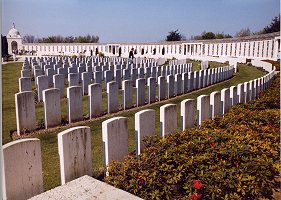
Graveyard at Ypres

Painting based on the Vietnam War Memorial

U.S.S. Arizona Memorial

World War II Memorial in Washington, D.C.

Raising the flag on Mt. Suribachi (Iwo Jima, 1945)

Canadian Army
IN FLANDERS FIELDS the poppies blow
Between the crosses row on row,
That mark our place; and in the sky
The larks, still bravely singing, fly
Scarce heard amid the guns below.
We are the Dead. Short days ago
We lived, felt dawn, saw sunset glow,
Loved and were loved, and now we lie
In Flanders fields.
Take up our quarrel with the foe:
To you from failing hands we throw
The torch; be yours to hold it high.
If ye break faith with us who die
We shall not sleep, though poppies grow
In Flanders fields.
Let us not forget.
Graveyard at Ypres
Painting based on the Vietnam War Memorial

U.S.S. Arizona Memorial

World War II Memorial in Washington, D.C.

Raising the flag on Mt. Suribachi (Iwo Jima, 1945)

17 April 2008
Questions
This is something I've debated before, and I have my own opinion on the matter, but I'd be curious to see what my readers think before I present mine. There are actually three closely related questions:
1) Is it permissible for men to wear earrings?
2) Is it permissible for women to wear earrings?
3) If the answer was no to (1) and yes to (2), on what do you base the distinction?
And, no, I'm not remotely considering get my ears pierced. My brothers already know what I'll do to their ear lobes if they ever come home with earrings.
In other news, I've posted again to my Theology/Philosophy blog. As I look at the previous post, I realize that I should have titled it "Presuppositionalism and "Calvinism": the Biblical Answers to the Problem of Epistemology." Not that anyone reads that blog (is it really that boring?), but it is duly fixed anyway. ;-)
And on my way home tonight I caught a portion of Rachmaninov's Rhapsody on a Theme of Paganini on the radio, so I'm going to listen to Bach's Toccata and Fugue in A minor (the one on my Songspot), and retire in a mood of pure bliss...
Colin
13 April 2008
Announcement and excerpt from USH2 paper
After about half a million edits...
Last Tuesday, I began turning a number of scenes that I've had in my head for a while into a story which I hope could end as a novella, at least. I have only the first chapter written and know what I want to do with the last two chapters; unfortunately, I only know the direction I want to take with the middle section, not the storyline. So I'm not going to bind myself to a set deadline for posting the next chapter, but if you'd like to read the first chapter at least, I've posted it to my Fiction/Poetry blog. I also submitted it, with a few poems, to the PHC Stylus literary publication. Input and criticism (from fellow Lit Snobs and all of my other friends who put up with our delusion that we're the coolest) is appreciated. I'd especially like suggestions for a main title; I currently plan for "Where the Wind Wills" to be a subtitle (and it is, by the way, a reference to John 3, not "Bohemian Rhapsody"...).
Also, our US History 2 paper is a comparison/contrast of Whittaker Chambers's Witness and Booker T. Washington's Up From Slavery. Up From Slavery was written in the late 1800s with Southern Reconstruction and the plight of the former slaves in mind, Witness in 1952 about the attempt to expose American Communism, but "for all their differences, they were both tales which brought the epic struggle between good and evil to a human level and made the principles applicable to the ordinary man by showing how ordinary men had fought and struggled with specific manifestations of that war," as I wrote in my paper.
The chief difference, though, in the authors' respective outlooks is one that struck me deeply as I was writing, and I devoted about a page to exploring that facet of their works. I may post more of the paper later, but here is the relevant excerpt for now:
"Washington was inspirational because he extolled the ability of men to raise themselves up from the ashes, and warned them not to allow their circumstances to dictate their future in such a way that they would never improve themselves. He was optimistic that the problems could be resolved and that the American people could put their dark past behind them in the next few generations. While acknowledging the faults of both parties in the past, he truly believed that they could be overcome by hard work and virtuous living—he believed that his object was attainable and that success lay within the volition of him and his fellow man.
Chambers was inspirational for nearly the opposite reason: he acknowledged that he was weak, and insisted that his role was thrust upon him against his will—but it was precisely the knowledge that this was his mission, arranged for him by destiny, that gave him the strength to fulfill it, because he knew that the same Providence that had assigned this terrible ordeal to him would direct the results, whether or not those results included his destruction. Chambers was willing to abandon all for the sake of the world and for the sake of destiny--and for his witness against Communism and for truth. He was pessimistic that his sacrifice would result in the ultimate salvation of the world—if it was not destroyed by Communism, it would fall prey to something else—but was certain that the guiding hand of God would nevertheless have a purpose even in this.
He thus inspired to play their part even men who are all too conscious of their own weakness. Their part need not be so crucial as his, nor need it be successful in human terms—whatever their part was, no matter how seemingly large or small, it formed a cog in the plan of Providence. He disagreed with the idea that the world would linearly improve; his hope lay in the ultimate end of the world which no human eye could yet see. This fundamental difference between Washington’s and Chambers’s presentations goes as deep as the level of their worldview, and could be described in religious terms as running as deeply as the difference between the theological concepts of merit and grace, for this is precisely the difference between them."
27 March 2008
Yet another US History post
It is odd that most of my philosophical discussions this semester are coming from a history class--I guess that is what I get for having already taken such foundational courses as Constitutional Law, Theology, Principles of Biblical Reasoning, and Philosophy and being left with Geometry, Rhetoric, Freedom's Foundations, and US History. I'll just say that I can't wait to start my major courses...
In the meantime, here is a conversation from US History, stemming originally from a discussion on the difference in American sentiment between World War II and our own day. The first section was written by one of my classmates (reprinted by his permission), and my response is two-fold.
"I think we're realizing that zeitgeist has a lot to do with the public response to government action (it may well be the biggest factor). The general feeling of the 40s was "we just conquered depression and we're damned proud of that," while today's seems to be a more whiny version of "this is hard and I don't like it."
We are what our parents were to our grandparents - rebellious wimps in need of a spanking and some chores. I don't want to rant (since that's so callow), but it seems that our generation of men needs a dose of warrior instinct (in the Fight Club and 300 vein) to combat lethargy and weak wills, while our generation of women needs a dose of motherly responsibility (in the Clara Barton and WWII Women vein) to combat neglect and this idea of an absolute right to total independence."
"Perhaps this is reopening a can of worms that was sufficiently aired last semester (though it doesn't have to be such a reopening), but I wish to point out that the "empowerment" of women and the effeminization of men go hand in hand. Unfortunately, as women are willing to take charge (or demand the reins [in the case of the suffragette movement), men are often all too willing to cede it, especially if they don't see any good reason to hold it themselves (this would be the case when they don't see the Scriptural command for them to be the head of their households and in church leadership, etc.). It could be debated which comes first, though that's not my object: they are definitely complementary. The more important issue is which needs to be changed first, as men simply asserting their authority/responsibility over unwilling women isn't going to get far (I believe I remember the slogan "forced submission isn't truly submission," and I agree to a point).
The other option is women dropping their power where it is the man's responsibility and leaving it to the men to step up. I'd question the practical wisdom of this initially, but it actually makes sense if one considers the point that if women aren't to have responsibility in a given area (and I'm not talking specifics right now), then it is not incumbent on them to hold up that area of responsibility. If something falls through because the men didn't stand up in their area of responsibility, it is their fault and responsibility--not the women's. Perhaps the women could show a bit more trust in God's providence in our respective spheres of responsibility--and perhaps a bit more trust that some, at least, of the men WILL step up. Just a thought.
In any case, I suppose I have quite enough to worry about as a man needing to take on my own responsibility.
Anyway, I was pondering what has caused the shift, and one cause at least is ironic. The public schools are rife with the idea of self-reliance and self-esteem and "believe in yourself." For that matter, some of the churches are (Joel Osteen, anyone?). But my suspicion is that these people are looking at themselves and suddenly find that they ARE weak. For all the individualistic propaganda, they find that the individual IS weak.
To an extent, the Great Generation and the generations before were also independent and self-reliant (like the pioneer stock they were), but they were not individualistic, and their independence was in a large way centered around others, if that makes sense. In other words, they had an "I can do this" attitude, because they were fighting for a principle higher than themselves and received strength to achieve their goals.
All that the contemporary individualist has to fight for is himself--and is it worth it?"
06 March 2008
And hello there...
For those who were rejoicing in my absence, my reduction in online presence is due to a tragedy striking my laptop's hard drive, which has gone to meet the great motherboard in the sky. I don't have as much time on my parents' desktop, so I've not been on here; I'm just updating right now to let you know that, yes, indeed I'm alive. Not much is new here, except that we've finished Dad's blacksmithing shed behind our garage, and we fired up the forge last Saturday and hammered away at some old railroad spikes. We have also tapped 12 of our maple trees for syrup, and the first batch is on the stove. Once we have some pictures of the whole process, I'll put some up!
I filled out this survey, too. Mayhap I ought to post my "Mother of all surveys" survey sometime (My DL friends and Michael K. should remember that one), just to get all possibilities for future survey questions out of the way. Ha!
Finally, in Freedom's Foundations, we are discussing the Constitution and the Federalist Papers; one of my classmates took the optimistic view that Americans are more educated than any other people in history, so are well equipped to make good political decisions--in short, we ought to be thankful and not be too worried about America. That prompted this essay, with which I shall leave you for now:
The Insufficiency of a Godless Education
By Colin Cutler
"Now what I want is, Facts. Teach these boys and girls nothing but Facts. Facts alone are wanted in life. Plant nothing else, and root out everything else. You can only form the minds of reasoning animals upon Facts: nothing else will ever be of any service to them. This is the principle on which I bring up my own children, and this is the principle on which I bring up these children. Stick to Facts, Sir!"
So opens Charles Dickens's Hard Times, with the schoolmaster being impressed--willingly--with the importance of "Facts." The novel is a bitter invective against this idea that "facts alone are wanted," and I would concur in Dickens's indictment.
It is said that the modern American is more educated, on average, than nearly anyone else in history. I disagree. I concede that more facts are being presented to more people in America than in most other countries at any given time in history. I disagree, however, because a debatable and insufficient definition of education is being used. First of all, education based solely on facts (as our public school system, by and large, is) neglects the personal aspect of humans; it reduces them to "reasoning animals." Ultimately, it can only teach them what has happened before them, not what they ought to do--and thus deprives them of direction for their reason.
More specifically, however, the emphasis of "education" upon facts is empty if one cannot understand those facts. Cornelius Van Til spoke of materialism as a system of uninterpreted facts--"brute facts," in his phrase--which, precisely because they simply existed without interpretation, could not be interpreted unless the materialist was willing to take a "leap of faith" in projecting a subjective interpretation of the fact. This would, of course, be a denial of everything materialism stands for. In other words, facts may be, but they have no meaning. And it is at this very point that materialism fails--and with it, the typical model of "education," which is indubitably founded on materialism.
A short digression: though the non-materialistic New Ageism has made some inroads in public schooling, as well, it is not the foundation of it. Further, I would agree with one of my professors in saying that the rebellion against God takes the form of a Janus face of rationalism/irrationalism. They are two sides of the same coin and, whether the proponents of each side realize it or not, are indispensable to each other. I make this point to qualify my identification of public schooling with strict materialism, but there is another point here that I will revisit below.
Yes, the children of America are taught facts. But are they taught how to analyze those facts and discover what they mean? Many high school students have read Shakespeare, but how many could tell the significance of Shakespeare's work and why it is relevant to us? You and I can see a statement of the human condition and the universe in Shakespeare's tragedies--as well as Shakespeare taking a shot at explaining why things are as they are--but how many students are taught anything more than "Shakespeare was a great author and you need to read 'Julius Caesar' for English so that you can see what great writing looks like"? Then they are lost because they can not see what is so great about Elizabethan language. They are told to define a "theme," "plot," and "tone," and can probably tell one what they think the theme, plot, and tone of a given story are, but how many can analyze that theme and tone in light of what it ultimately means and whether or not it is an accurate summation of reality?
It is analyzation that America's "education" fails to teach, and precisely analyzation that materialism implicitly forbids, if taken to its ultimate conclusion. The teachers are then reduced to asking the students what they think of the works and what it means to them. Here we see the irrationalist side of rebellion. Though few take it as far as Derrida's Deconstructionism, the emphasis is on subjective interpretation, with little or no regard for the objective Facts of who the author was, his historical context, his religious beliefs, etc.
Further, we as Christians are to see the Facts in their historical context as a part of God's plan of history. A Divine "plan of history" is, of course, wholly discarded by materialists; there are fatalists, naturally, but their sense of destiny is deterministic, not based in a Divine Providence. We must be careful that we also do not divorce the facts of history from their meaning as a part of God's plan for His universe. Frankly, if a person is not taught God's interpretation and purpose in history (and thus the meaning of the facts of history), he is not educated. If a person is taught in a materialistic mold, not only is God excluded, but he has no way of making any sense of the facts. He has no purpose, and facts--his "education"--will do him little good in such a state.
17 February 2008
Psalm 90
A Prayer of Moses, the man of God
1Lord, thou hast been our habitation from generation to generation.
2Before the mountains were made, and before thou hadst formed the earth, and the world, even from everlasting to everlasting thou art our God.
3Thou turnest man to destruction; again thou sayest, Return, ye sons of Adam.
4For a thousand years in thy sight are as yesterday when it is past, and as a watch in the night.
5Thou hast overflowed them; they are as a sleep: in the morning he groweth like grass;
6In the morning it flourisheth and groweth, but in the evening it is cut down and withereth.
7For we are consumed by thine anger, and by thy wrath are we troubled.
8Thou hast set our iniquities before thee, and our secret sins in the light of thy countenance.
9For all our days are passed away in thine anger: we have spent our years as a thought.
10The time of our life is threescore years and ten; and if they be of strength, fourscore years: yet their strength is but labour and sorrow; for it is cut off quickly, and we flee away.
11Who knoweth the power of thy wrath? For according to thy fear is thine anger.
12Teach us so to number our days, that we may apply our hearts unto wisdom.
13Return (O LORD, how long?) and and be pacified toward thy servants.
14Fill us with thy mercy in the morning; so shall we rejoice and be glad all our days!
15Comfort us according to the days that thou hast afflicted us, and according to the years that we have seen evil.
16Let thy work be seen toward thy servants, and thy glory upon their children.
17And let the beauty of the LORD our God be upon us: and direct thou the work of our hands upon us, even direct the work of our hands.

07 February 2008
The Government majors are at it again...
Somehow this week's US History forum turned into a discussion of politics and candidates and all that jazz that's been on the news. I can't imagine how... Anyway, what I posted there is relevant here, and is pretty much my perspective on this whole election thing. It always helps to get things back to first principles.
"Whilst it has been fun listening to all you government majors rant and rave about how America is going down the tubes with liberal Democrats and liberal Republicans and Third Party pipe dreams, I already knew all that. I shall go quietly to the Nebraska primaries on May 15th and cast my vote dutifully as a citizen, quite probably blog my opinion, and possibly participate in some "get out the vote" stuff, and then leave the results in God's hands. It's not the end of the world, folks. Or if it is, then so be it.
Just remember:
Daniel 4:25 "...the Most High is sovereign over the kingdoms of men and gives them to anyone He wishes."
Proverbs 21:1 "The king's heart is in the hand of the Lord; he directs it like a watercourse wherever He pleases."
I pray for the sake of the Church and for our peace as homeschoolers that we may be given a just ruler, but if we are given an evil ruler in judgment on our national sins, so be it. Our brothers in the Middle East and China and Eastern Europe (and Germany) would still love to live here. One of our very own DL professors (Dr. Erdmann) had to flee Germany a couple years ago because his family was homeschooling, and now lives in Switzerland where he must hold 4 or 5 jobs to keep up with the cost of living. Count your blessings.
Now I'm off to make a post on HISTORY.... ;-)
Your Tory friend,
For Monarchy and the Divine Right of Kings (you can't get much further to the right than that),
Colin"
Subscribe to:
Posts (Atom)

